
11.18.2026
The Temple of Debod is one of the most unusual monuments in Madrid. Located in Parque del Oeste, close to Plaza de España, this ancient Egyptian temple stands out among the city's historic buildings and offers visitors the chance to see an authentic monument from ancient Egypt without leaving Spain.
Surrounded by gardens and open spaces, the temple is also a popular place to enjoy views over western Madrid. Its history, architecture and location make it an interesting stop when exploring the Spanish capital.
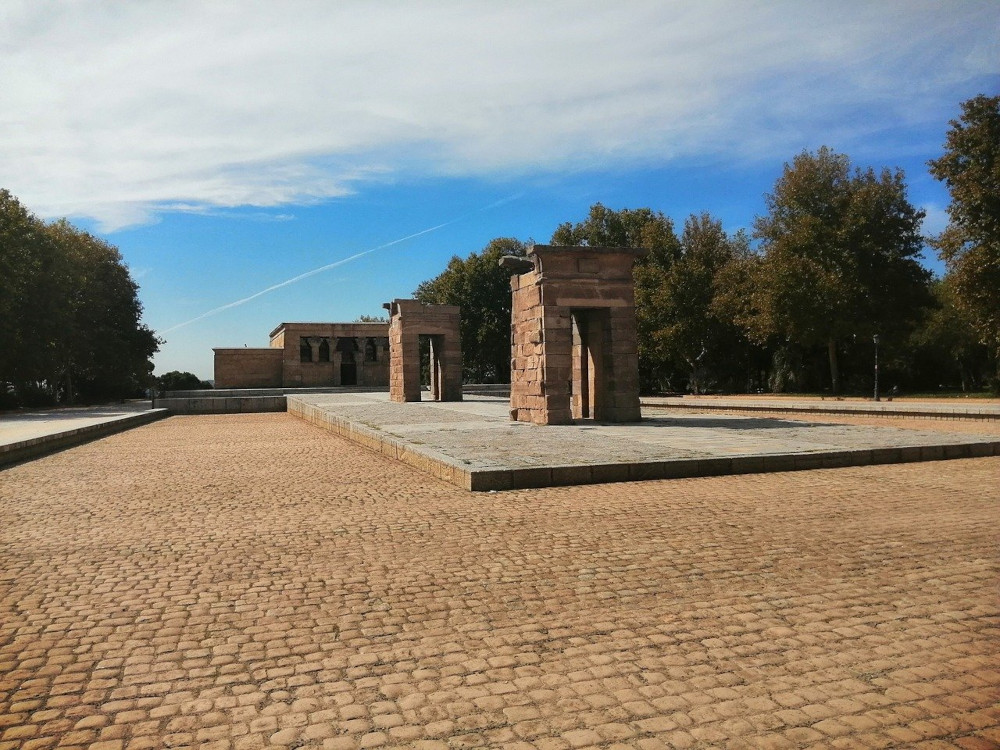
The Temple of Debod was originally built in the region of Nubia, in southern Egypt, near the Nile River. Its construction began around the 2nd century BC, during the reign of the Meroitic king Adikhalamani, who dedicated the original chapel to the god Amun.
Over the following centuries, different rulers of the Ptolemaic dynasty and Roman emperors added rooms, decorations and inscriptions to the building. The temple became associated with the worship of Amun and the goddess Isis, and its walls preserve examples of ancient Egyptian religious art.
Like other monuments in Nubia, the temple was threatened by the construction of the Aswan dams. The international campaign led by UNESCO to protect archaeological sites in the region helped save several important monuments, including the temples of Abu Simbel.
Spain took part in the international campaign to save the monuments of Nubia through archaeological work and financial support. In recognition of this contribution, the Egyptian government donated the Temple of Debod to Spain in 1968.
The temple was dismantled stone by stone and transported to Spain in 1970. Its blocks were then reassembled in Madrid, in the area occupied by the former Cuartel de la Montaña, near Parque del Oeste and Plaza de España.
After the reconstruction, the monument was officially opened to the public on 20 July 1972. Today, it is one of the few complete ancient Egyptian temples that can be visited outside Egypt and a distinctive part of Madrid's cultural heritage.
The Temple of Debod is made up of several connected spaces arranged along an east-west axis. Its original stone blocks were carefully numbered during dismantling so that the building could be reconstructed in Madrid.
Visitors can appreciate the entrance area, the stone gateways, the chapel and the decorated interior spaces. The reliefs and inscriptions provide a glimpse into the religious beliefs and artistic traditions of ancient Egypt.
Although the monument is smaller than the great Egyptian temples, its original structure and historical details make it a remarkable example of ancient architecture. Its setting in an open park also allows visitors to view the building from different angles.
The temple stands in the gardens of Parque del Oeste, a green area near Plaza de España and the western side of Madrid's historic centre. The surrounding grounds include open lawns, paths, trees and water features that form part of the monument's setting.
The elevated position offers views towards the Casa de Campo and the western part of the city. The area is especially popular in the late afternoon, when visitors gather to enjoy the changing light around the temple.
The gardens are a pleasant place to walk and take photographs, and the visit can easily be combined with other nearby attractions such as Plaza de España and the Royal Palace of Madrid.
The Temple of Debod is particularly popular at sunset. The warm light on the stone walls and the reflections in the surrounding water create an attractive setting for photography.
Many visitors come to the gardens in the late afternoon to watch the sunset over the western horizon. It is a good time to enjoy the views, although the area can become busy, especially at weekends and during holiday periods.
If you plan to visit the interior of the temple as well, remember that access is subject to its opening hours and capacity limits. You can enjoy the gardens and the exterior of the monument separately from the indoor visit.
The Temple of Debod is located at Calle Ferraz, 1, close to Plaza de España in Madrid. Its location makes it easy to include in a walking tour of the city centre.
The nearest metro stations are Plaza de España, served by lines 3 and 10, and Ventura Rodríguez, on line 3. Príncipe Pío railway station is also within walking distance.
The temple is surrounded by the gardens of Parque del Oeste, where visitors can enjoy open spaces and views over the western part of Madrid. Please note that the interior of the monument is not accessible to visitors with reduced mobility.
The Temple of Debod is well located for exploring several attractions in western Madrid. Plaza de España is just a short walk away, while the Royal Palace of Madrid and Almudena Cathedral are also nearby.
From this area, you can continue towards the historic centre and visit other well-known places such as Puerta del Sol and Plaza Mayor. These attractions can be included in a walking route through some of the most representative parts of the Spanish capital.
For more ideas, take a look at our guides to the Royal Palace of Madrid, Puerta del Sol and Plaza Mayor.
If you are planning your visit or travelling to the Spanish capital, you can check the current time and date in Madrid on our world time page.
The Temple of Debod is a unique attraction that brings a part of ancient Egyptian history to Madrid. Its origins in Nubia, its journey to Spain and its reconstruction near Plaza de España make it one of the city's most distinctive monuments.
Whether you are interested in history, architecture or photography, a visit to the temple and its gardens is a worthwhile addition to a trip to Madrid.
Archive: Travel articles by country › Spain
Discover more places in Madrid:
• Madrid tourist attractions
• Royal Palace of Madrid
• Retiro Park
• Puerta del Sol
• Plaza Mayor